What pure water is
Tap water has minerals dissolved in it, like calcium and magnesium. You can see them in the scale on a kettle. When tap water dries on glass, those minerals are left behind as spots and smears. That's why traditional window cleaning uses a squeegee to get the water off before it dries.
Purified water has had those minerals taken out. With nothing dissolved in it, it dries without leaving anything behind. That's the whole trick.
How it's made
Window cleaners usually purify water in two stages.
Reverse osmosis
Tap water is pushed through a very fine membrane that lets water through and holds most of the dissolved minerals back. This takes out the bulk of them.
Deionisation
The water then runs through a resin that takes out what's left. The result is water with close to nothing in it.
The water is tested with a meter that reads the total dissolved solids, the amount of stuff in it. For window cleaning it should read zero, or very close. A good contractor checks it.
How the cleaning works
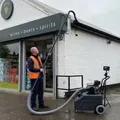
The purified water is pumped up a long, light pole with a brush on the end, usually made of carbon fibre. The cleaner stands on the ground and works the brush over the glass and frames. The brush loosens the dirt, and the pure water carries it away. Then the glass is rinsed with pure water and left to dry.
Because pure water dries clear, there's no need for a squeegee, and no soap. Nothing is left on the glass to attract new dirt, so it tends to stay clean for longer than glass cleaned with soap.
Frames and sills are cleaned at the same time, because the brush reaches them easily. With traditional cleaning they often get missed.
Why it's safer
The Work at Height Regulations 2005 say work at height should be avoided where it reasonably can be. A water-fed pole lets the cleaner reach upper floors while standing on the ground. That means no ladders propped against your building, no ladders across entrances, and nothing for staff, customers or pupils to walk under.
For a facilities manager it also makes the paperwork simpler. The main risks on a pole job are on the ground: hoses, wet paving and people walking past. They're easy to manage with cones and care.
How high it can reach
Most buildings up to about four storeys can be cleaned from the pavement or car park. The exact reach depends on the pole, the angle and how close the cleaner can stand to the wall.
Glass above that, glass set back behind a roof, atriums and roof lights need other access, usually a cherry picker. A good contractor tells you at the quote which parts those are and prices them in, so there are no surprises on the day.
Can it be done in the rain?
In light rain, yes. Rainwater itself is fairly clean. It's the dust and dirt it lands on that leaves marks. Glass cleaned with pure water and rinsed well can be rained on and still dry reasonably clear. Heavy rain, high wind and freezing weather stop the work.
What it can't do
- Inside glass. That's done the traditional way, usually out of hours
- Very old, baked-on marks, like hard water staining, paint or cement splashes. These need treating separately, and some won't come off fully
- Glass that's out of reach of the pole, without other access
- Glass behind security grilles or tight planting, where the pole can't get to it
The first clean on glass that's been done with soap for years can take longer. Old residue in the frames and seals needs rinsing out, or it runs onto the glass. After a visit or two that settles down.
Is it better for the environment?
There's no soap or detergent, so nothing goes onto planting, paving or into drains except water and the dirt it carried off. The purifying process does use water, because reverse osmosis sends some to waste as it filters. The pure water is usually carried in tanks on the van, so the job doesn't need a tap on your site.
Where else it's used
Pure water isn't only for windows. It's the best way to clean solar panels, because there's no detergent film left to hold new dirt and nothing to mark the glass. We clean panels with a long water-fed pole and pure water. More in our guide on whether solar panel cleaning pays for itself.
It's also gentle on signs and glass canopies.
How we use it
We clean commercial glass with water-fed poles and purified water. Most of it is done from the ground, on a schedule that suits the building, from every four weeks to a few times a year. In Essex we do the work ourselves. Elsewhere it's done by a local specialist we've vetted, with insurance checked and RAMS agreed before they go on site. You deal with us throughout.
See commercial window cleaning for more, or our guide on what sets the price.