The short answer
Most commercial buildings need their gutters cleared once a year, in late autumn once the leaves are down. Buildings with trees close by usually need two clears, one in late autumn and one in spring. Flat roofs and box gutters should be checked every year, even if they look fine from the ground.
Why it matters more on a commercial building
On a house, a blocked gutter is a nuisance. On a commercial building it can be expensive. Gutters on offices, schools and units are often long runs feeding a small number of downpipes. One blocked outlet can send a lot of water down the face of the building.
When gutters overflow, the water runs down walls, soaks brickwork and render, and finds its way in round windows and through roofs. Box gutters and valley gutters, which sit inside the line of the roof, are worse. When they block, the water has nowhere to go but into the building.
Clearing gutters is one of the cheapest bits of building maintenance. Fixing the damage from blocked ones isn't.
What decides how often
Trees
Leaves, seeds, twigs and blossom all end up in gutters. A building next to mature trees can fill its gutters in a single autumn. Twice a year is the usual answer.
Moss on the roof
A mossy roof sheds moss into the gutters all year round, especially after frost and heavy rain. If the roof needs cleaning, clear the gutters straight after. Our guide to commercial roof moss covers that.
Flat roofs and box gutters
Flat roofs collect silt, moss and litter round their outlets. Box gutters are hard to see from the ground. Both should be checked every year.
Birds
Pigeons and gulls nest in and round gutters, and their nests and mess block outlets. Buildings near the coast or town centres often have more of this.
The building itself
Low-pitch roofs, long gutter runs with few downpipes and gutters with lots of corners all block more easily.
Signs your gutters are blocked
- Water pouring over the edge in heavy rain
- Plants or moss growing out of the gutter
- Green or dark streaks down the walls below the gutter
- Damp patches on inside walls near the top of the building
- Downpipes that don't run when it's raining
- Puddles or splash marks at the foot of a wall with no downpipe
If you see any of these, don't wait for the next planned clear.
What a proper clear should include
The gutters are only part of it. A clear that leaves the downpipes blocked hasn't fixed anything.
- Every gutter run cleared, including the back and sides of the building
- Outlets cleared where the gutter meets the downpipe
- Downpipes checked and cleared if they're blocked
- All waste bagged and taken away, not left at the foot of the wall
- Photos or camera footage of the gutters before and after
- A note of anything broken: loose brackets, leaking joints, cracked sections
That last point is worth asking for. The person clearing your gutters is in the best position to spot problems early, and a photo is far more useful than "looked fine".
How we do it
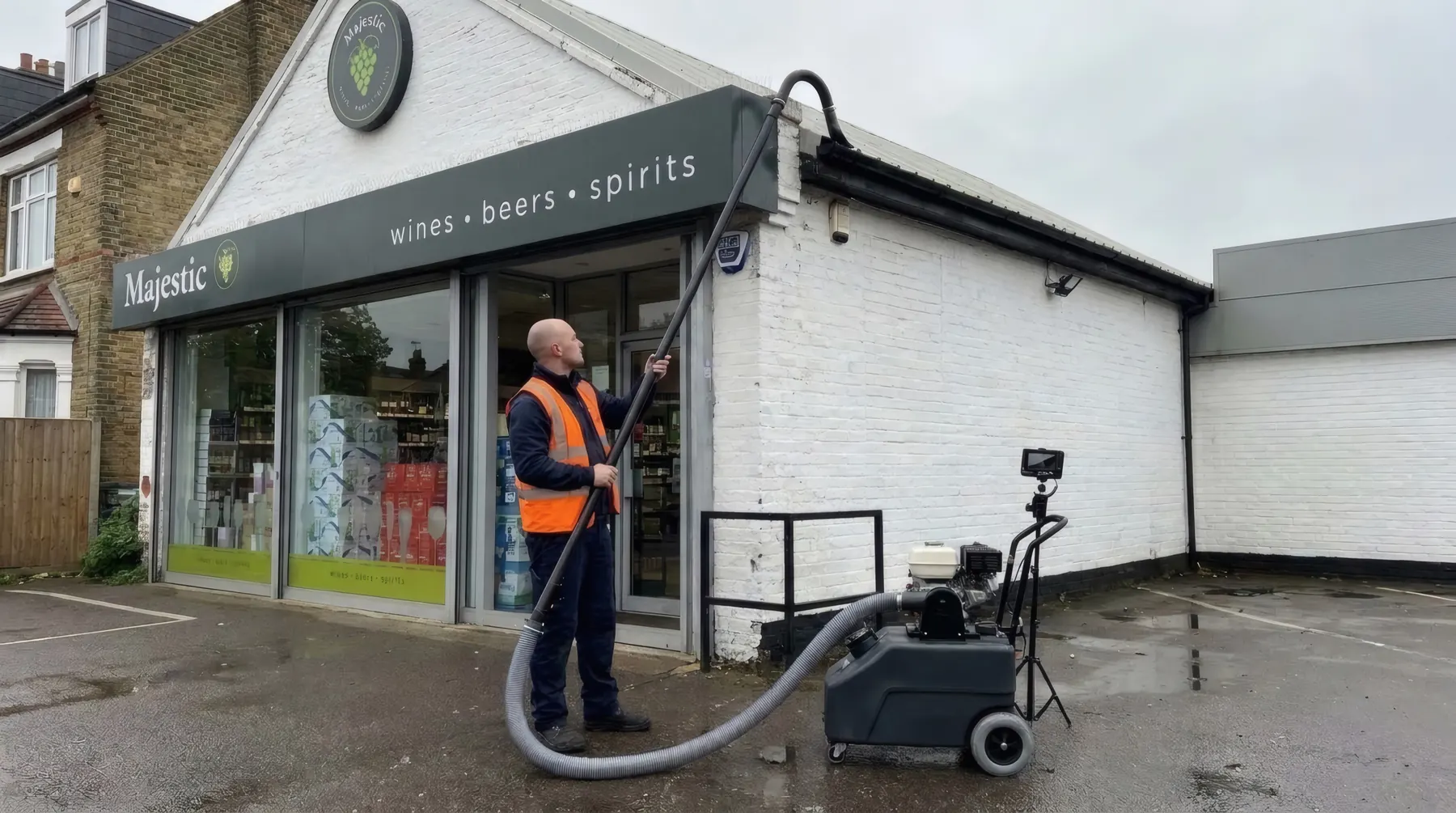
In Essex we use a gutter vacuum on long poles, worked from the ground, with a camera on the end. Nobody climbs a ladder or walks on the roof, and the camera shows what's inside the gutter. You get the pictures, so you can see it's been done. Blocked downpipes are cleared too, and the waste is taken away.
Elsewhere in the UK, the method depends on the building and is set out in the method statement before work starts. A local specialist we've vetted does the work, with their insurance checked first. We stay your contact.
Our company is running a gutter clearance programme across 80 Majestic Wine stores, as a subcontractor to the facilities firm Shebang FM. About 30 stores are done so far.
Do gutter guards stop it?
Gutter guards and mesh covers keep out leaves and bigger debris, and on some buildings they help. They don't stop fine silt, seeds and moss, which build up on top of the mesh or slip through it. Moss can grow on the guard itself. A guarded gutter still needs checking, and when it does need clearing, the guards have to come off first. If you have them, tell your contractor so it's priced in.
When to book
Late autumn is the busiest time for gutter clearing, because that's when everyone needs it. If you know you'll need a clear in November, book it in early autumn. A spring clear is usually easier to get.
If you have several jobs on the outside of the building, think about the order. Roof cleaning first, then gutters, so the moss that comes off the roof doesn't sit in a freshly cleared gutter. Our yearly exterior cleaning checklist sets out a full year.
More on commercial gutter clearing.