Why there's no single answer
You'll find all sorts of figures online for how much output dirty panels lose. They vary because the panels vary. A steep array on a clean suburban roof that gets rained on often may lose very little. A low-pitch array next to a farm, a busy road or a gull colony can lose a lot more.
So rather than trust a general figure, it's better to look at your own panels and your own data. Most commercial systems have monitoring that makes this straightforward.
Which panels get dirty fastest
Low pitches
Rain washes steep panels reasonably well. On shallow pitches, common on warehouses and flat-roofed schools, water sits on the glass and dries, leaving dirt behind. A line of grime often builds up along the bottom edge where water collects against the frame.
Near farms, roads and industry
Dust from fields, traffic film from main roads and fallout from industrial sites all settle on the glass. Panels near quarries or building sites get it worst.
Near the coast
Salt spray dries to a film.
Birds
Bird mess is the big one on many sites. It blocks light completely in one spot instead of dimming the whole panel. Because cells in a panel are linked, shading one part of a panel can pull down the output of more than just that patch, and a heavily shaded cell can run hot.
Trees
Sap, pollen and leaf litter, plus lichen and moss in shaded spots.
How to work out if it's worth it
You need three things: how much the panels generate, how much they generate when clean, and what each unit of electricity is worth to you.
1. Look at your monitoring
Pull up your generation for a few clear, sunny days. Write down the total for each.
2. Clean, then compare
After the clean, find a few clear days with similar sunshine at a similar time of year, and compare. The comparison is never perfect, because no two days are the same. But on a sunny week either side of a clean, the difference is usually plain to see.
Some sites compare one row or section of panels before cleaning the rest. That gives a cleaner comparison on the same day.
3. Put a value on it
If you use the electricity on site, each extra unit is a unit you don't buy from the grid. Value it at what you pay per unit. If you export it, value it at your export rate, which is usually lower. Most businesses use most of what they generate, so the grid price is usually the right one.
Multiply the extra units by that price, over the months until the panels are dirty again, and compare it with the cost of the clean. That's your answer, from your own figures.
4. Check the warranty and the paperwork
Some panel makers set out cleaning guidance in their warranty terms, such as no pressure washers and no abrasive cleaners. A record of regular, gentle cleaning is useful if you ever need to make a warranty claim.
When it's most likely to pay
- Low-pitch arrays that the rain doesn't wash well
- Panels near farmland, main roads, the coast or industry
- Sites with a lot of birds
- Large arrays, where a small gain per panel adds up
- Businesses that use most of their power on site in the daytime
If none of those apply, and your monitoring shows little change after a clean, once a year or less is probably plenty.
How panels should be cleaned
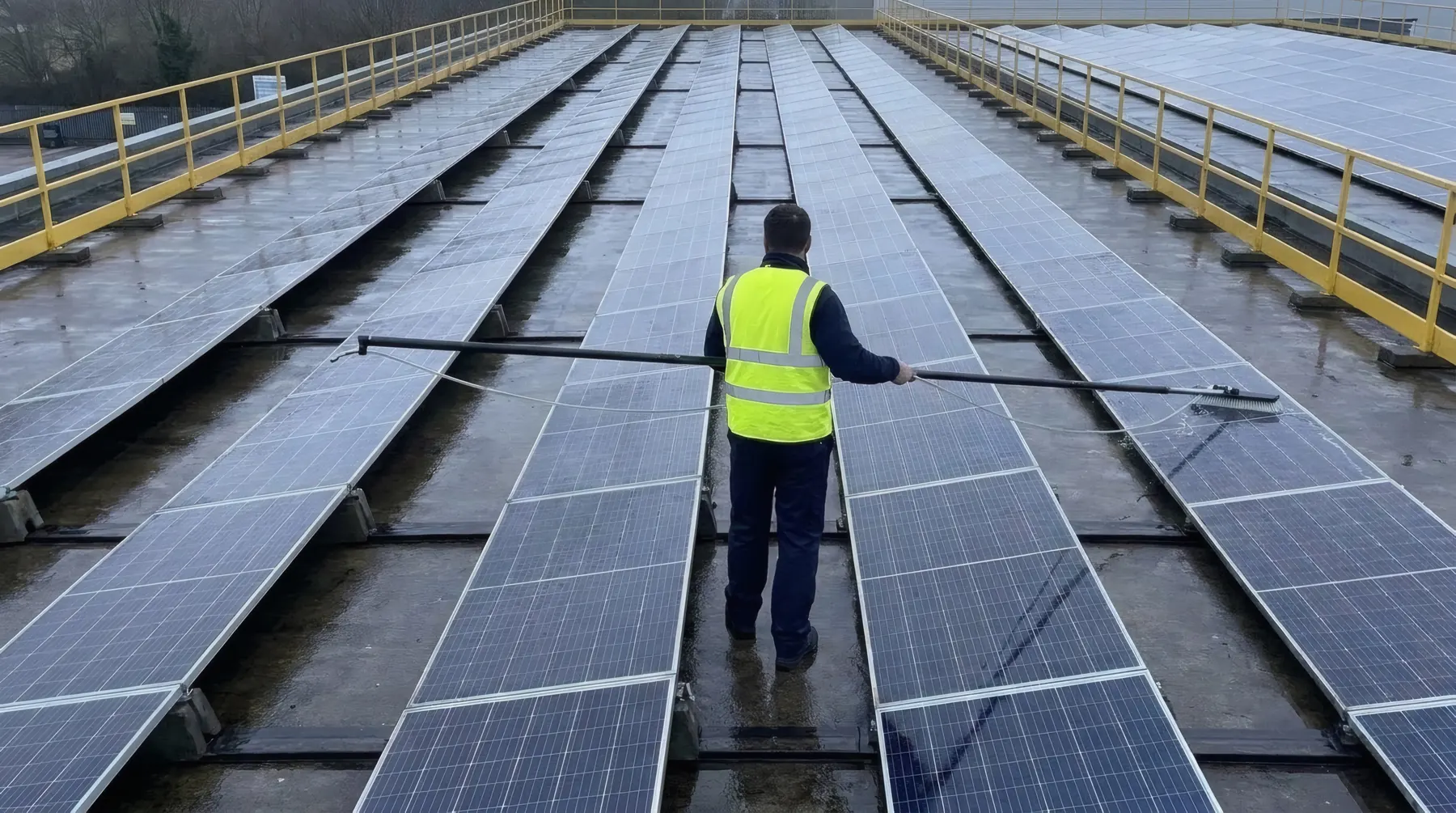
With purified water and soft brushes. No detergent, because soap leaves a film that holds new dirt. No pressure washer, because high pressure can damage seals and the coating on the glass. Purified water has nothing in it to leave marks, so the glass dries clear. Our pure water guide explains how that works.
We clean panels with a long water-fed pole and purified water, from the ground or a safe edge where we can. If your array can't be reached that way, we tell you at the quote what access it needs.
A water clean from the outside doesn't need the system switching off. Tell us the make of the system and we'll check its cleaning guidance.
How often
- Most commercial arrays: once a year
- Near farms, roads or the coast: twice a year
- Low-pitch roofs: once or twice a year
Spring is a good time for a clean, ahead of the long days when the panels earn the most. Your monitoring will tell you if a second clean in late summer is worth it.
What you get
Photos before and after, and a note of anything we spotted, like cracked glass, loose fixings or panels with heavy soiling. That's useful for your maintenance file even if the clean itself only adds a little.
In Essex we do the work ourselves. Elsewhere it's done by a local specialist we've vetted, with insurance checked and RAMS agreed first. See solar panel cleaning for more.